
Probability mass function
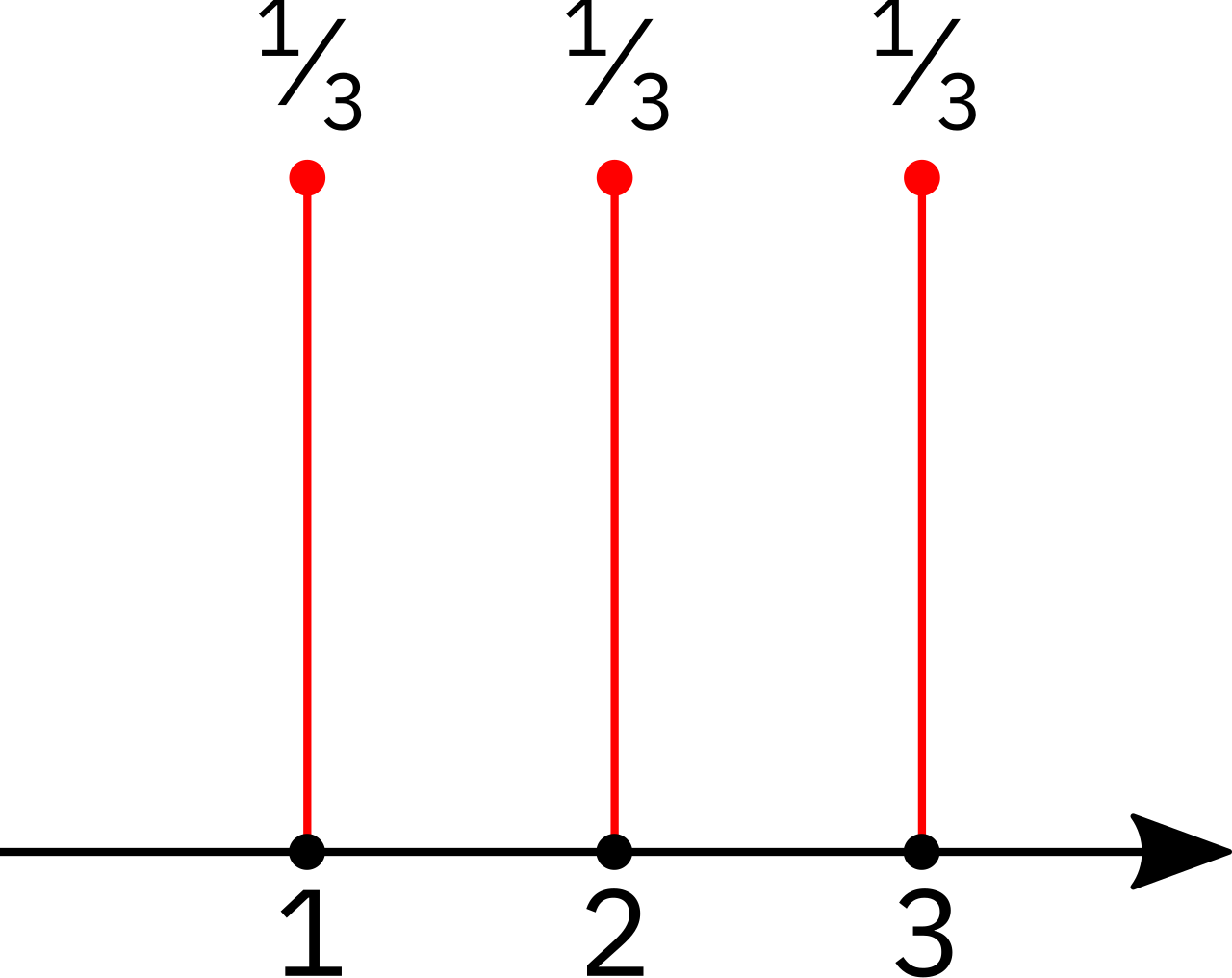
Function giving probability of a discrete random variable equaling a value.

HB · CC BY-SA 4.0
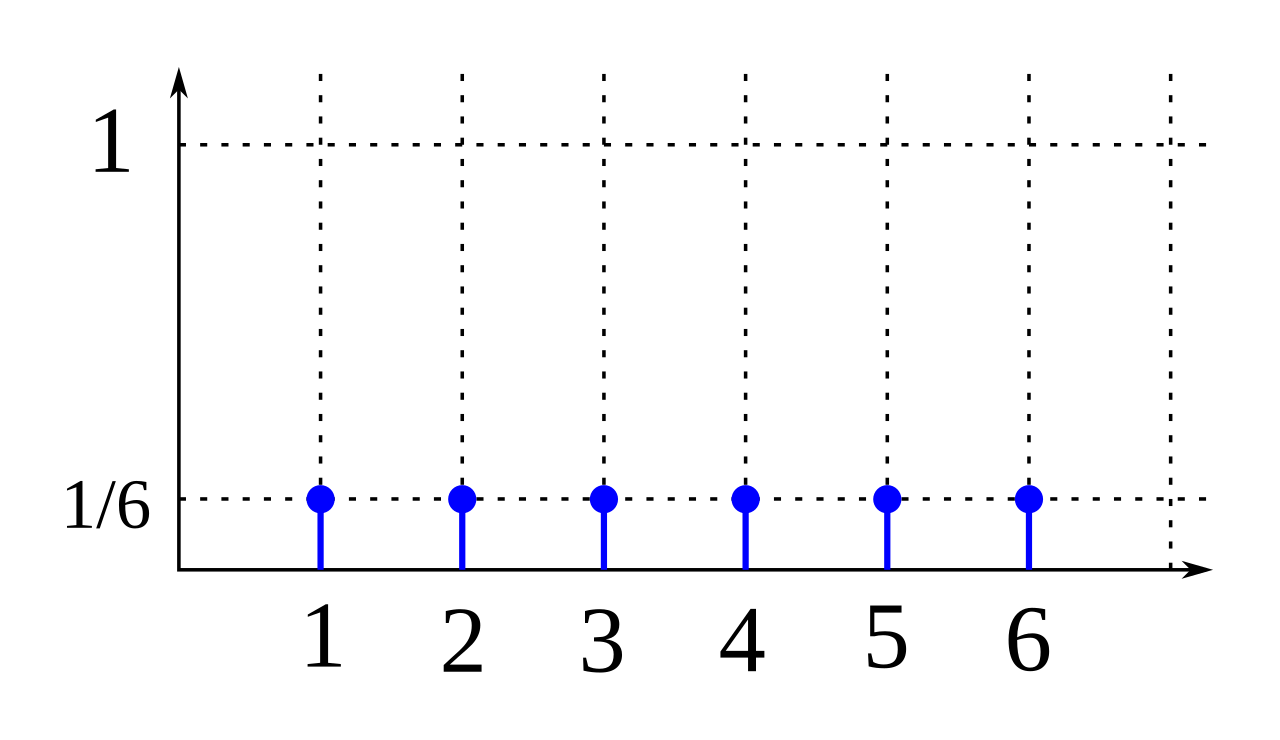
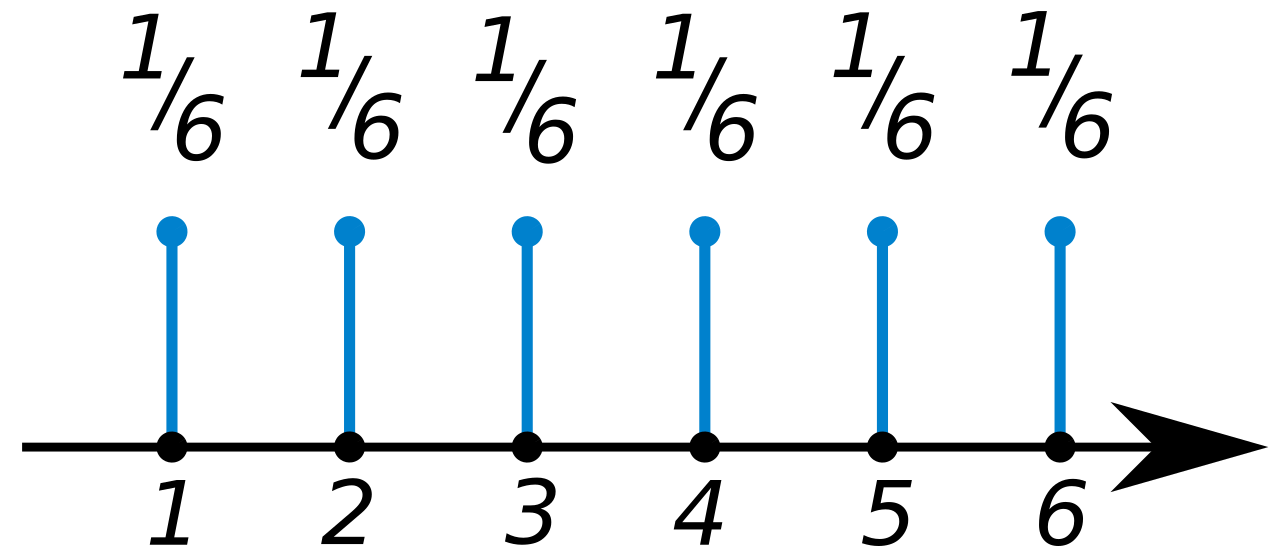
In probability and statistics, a probability mass function (sometimes called probability function or frequency function) is a function that gives the probability that a discrete random variable is exactly equal to some value. It is often the primary means of defining a discrete probability distribution, and such functions exist for either scalar or multivariate random variables whose domain is discrete. The probability mass function differs from a continuous probability density function (PDF) in that the latter is associated with continuous rather than discrete random variables.
- field
- Probability and statistics
- known_for
- Defining the probability distribution of discrete random variables
- related_concept
- Mode (value of the random variable having the largest probability mass)
- key_property
- Probabilities sum to 1 and are non-negative
Lore & Background
The probability mass function is defined as a function p: R → [0,1] where p_X(x) = P(X=x) for a discrete random variable X. The probabilities associated with all hypothetical values must be non-negative and sum to 1, analogous to conservation of physical mass. The value of the random variable having the largest probability mass is called the mode.
Reader's Guide
The probability mass function is a fundamental concept in probability and statistics, serving as the primary means of defining a discrete probability distribution. It provides the possible values of a discrete random variable and their associated probabilities. Unlike a continuous probability density function, which must be integrated over an interval to yield a probability, the probability mass function directly gives the probability at each discrete point. The function is zero for all but a countable number of values, and its discontinuity is related to the fact that the cumulative distribution function of a discrete random variable is also discontinuous. In measure-theoretic terms, the probability mass function can be seen as a special case of the distribution of a random variable or as the probability density function with respect to the counting measure. Thinking of probability as mass helps avoid mistakes since physical mass is conserved, as is the total probability for all hypothetical outcomes.
Did You Know?
- The probability mass function is sometimes known as the discrete probability density function.
- The value of the random variable having the largest probability mass is called the mode.
- The probabilities associated with all hypothetical values must be non-negative and sum up to 1.
- The probability mass function is zero for all but a countable number of values of x.
Defining Discrete Uncertainty
A probability mass function serves as the fundamental tool for quantifying the likelihood that a discrete random variable lands on a particular value. Often referred to simply as a probability function or frequency function, and occasionally called a discrete probability density function, it stands as the primary mechanism through which a discrete probability distribution is formally defined. What makes this concept versatile is that it applies not only to single scalar random variables but also to multivariate settings, provided the underlying domain remains discrete. The name itself carries a useful physical intuition. By thinking of probability as a kind of mass spread across possible outcomes, one gains a natural safeguard against common errors. Just as physical mass in a closed system is conserved, the total probability assigned across all hypothetical outcomes must remain fixed. This conservation principle underpins every calculation involving a PMF and gives practitioners an intuitive check: if your assigned probabilities do not behave like a conserved quantity, something has gone wrong in your model.
Axioms and the Mode
Formally, a PMF is a function mapping real numbers into the closed interval from zero to one, defined over the entire real line. It is built upon a probability measure and can be written in its full notation as p subscript X of x, or more compactly as simply p of x. Two axioms govern every valid PMF without exception. First, no individual outcome may be assigned a negative probability; every value in the range must be zero or greater. Second, when you sum the probabilities across every possible value the random variable can take, the total must equal exactly one. Among all the values a discrete random variable might assume, the one that carries the greatest probability mass holds a special designation: it is called the mode. This single number identifies the most likely outcome in the distribution and serves as a quick descriptive summary. Together, the non-negativity constraint, the normalization requirement, and the identification of the mode form the structural backbone that distinguishes a legitimate PMF from an arbitrary assignment of numbers to outcomes.
Discrete Versus Continuous: A Key Distinction
One of the most important conceptual boundaries in probability theory separates the PMF from the continuous probability density function. While both objects describe how probability is allocated across possible outcomes, they operate in fundamentally different domains. A PMF is tied exclusively to discrete random variables, where the variable can only take on values from a countable set. In contrast, a continuous PDF is associated with random variables that can assume any value within an interval. This difference has a direct practical consequence for how one extracts probabilities. With a PMF, you simply read off the value at a specific point to learn the probability of that exact outcome. With a continuous PDF, the value at a single point does not represent a probability at all; instead, one must integrate the density function over an entire interval to obtain the probability that the variable falls within that range. The PMF is sometimes called a discrete probability density function, but this label should not blur the essential operational distinction between summing point masses and integrating a continuous curve.
The Measure-Theoretic Underpinning
At a deeper level of mathematical abstraction, the PMF emerges as a special case within the broader machinery of measure theory. Given a probability space consisting of a sample space, a σ-algebra, and a probability measure, and a measurable space whose underlying σ-algebra is discrete—meaning it contains all singleton sets—a random variable mapping from the first space to the second is classified as discrete whenever its image is countable. In this framework, the pushforward measure of the probability, often called the distribution of the random variable, is a probability measure on the target space. When this measure is restricted to singleton sets, it precisely recovers the PMF: the probability that the variable equals a given element equals the measure of the preimage of that element. Furthermore, if the target space is equipped with the counting measure, the PMF can be expressed as the Radon–Nikodym derivative of the pushforward measure with respect to that counting measure, yielding a function from the target space into the non-negative reals.
Gallery

Frequently Asked Questions
What is a probability mass function?
A probability mass function (PMF) is a function that assigns a specific probability to each possible outcome of a discrete random variable. In plain terms, it tells you exactly how likely the variable is to land on one particular value.
How does a probability mass function differ from a probability density function?
The PMF is built for discrete random variables, where you can meaningfully talk about the probability of a single exact value. A PDF, by contrast, belongs to the continuous world, where probability is spread over intervals rather than concentrated at points.
What are the two key properties every probability mass function must satisfy?
Every individual probability it outputs must be non-negative, and the sum of the probabilities across all values in the domain must equal exactly 1. These two conditions guarantee the function behaves as a valid probability assignment.
What is the primary role of a probability mass function in probability theory?
It is the standard tool for fully defining a discrete probability distribution. Once you specify the PMF, you have a complete description of how probability is allocated among all discrete outcomes.
What does 'mode' mean in the context of a probability mass function?
The mode is the value of the random variable that carries the largest probability mass under the PMF. It represents the single most likely outcome according to that function.
More in Probability & Statistics 1-24
Elsewhere in the Probability & Statistics universe
Spotted an error? Know more?
This is a living reference — every entry is fact-audited, and reader corrections feed straight into our audit queue. Suggest an edit · See this site's audit record